Raising Backyard Chickens: What 3-12 Hens Actually Cost You
The first month of keeping chickens is the expensive one, and it isn't close. Almost everything you'll ever spend on a small flock lands before the first egg shows up in a nest box — coop, run, hardware cloth, feeder, waterer, brooder gear. After that, the bill flattens into something closer to a modest utility line, and it's predictable enough to budget a year ahead once you know the two numbers that actually move it: how many birds you keep, and what a bag of layer feed costs where you live.
So this isn't a piece with one national figure for a coop, because there isn't one. It's a structure you can drop your own prices into. Bring a phone, a feed store website, and five minutes.
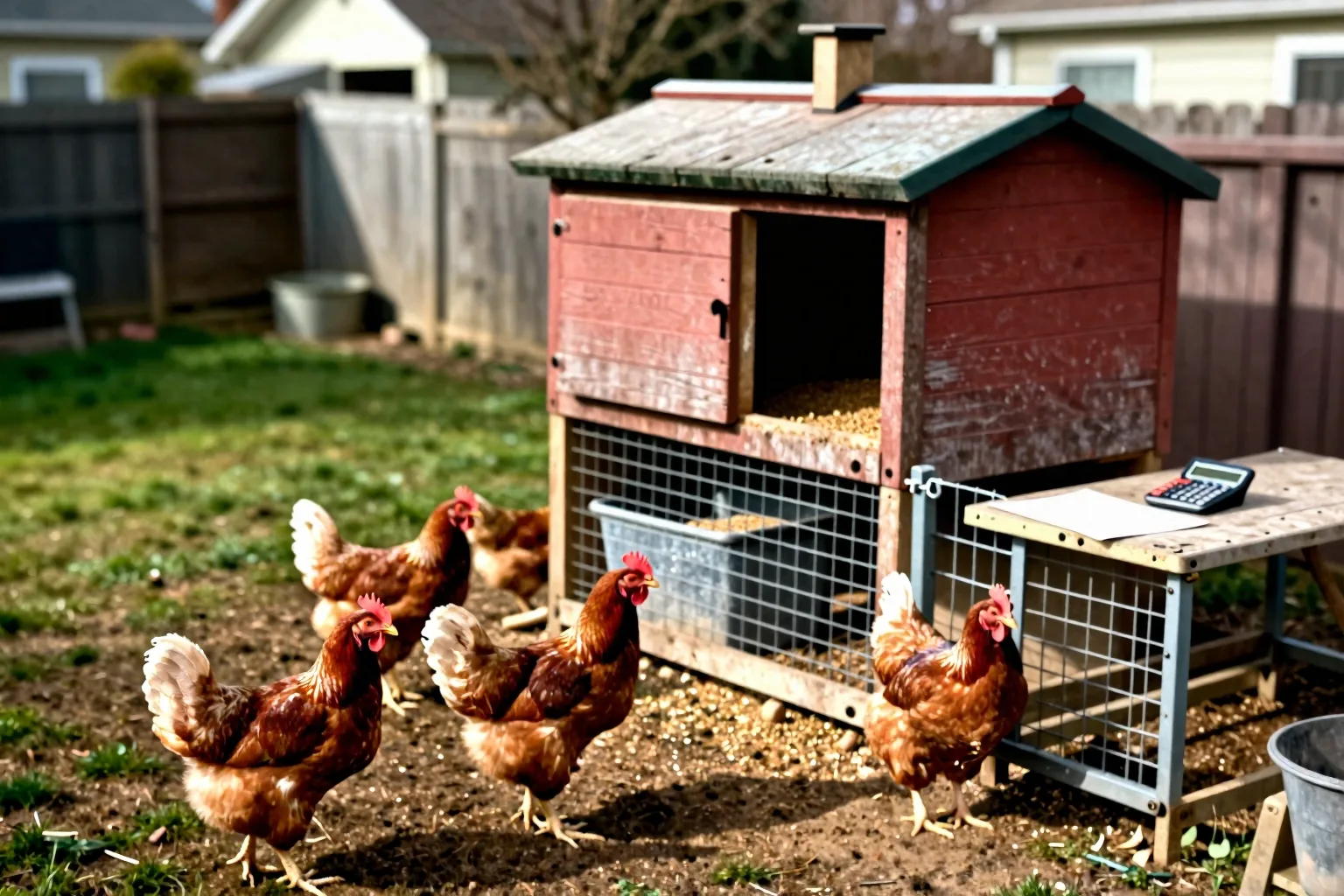
Startup Costs: Coop, Run, and Equipment for 3-12 Birds
Start with the shelter, because it's the single biggest cheque you'll write. The working figures most small-flock keepers build around are about 4 square feet of coop floor per standard-size hen and 8 to 10 square feet of run — more if the birds stay shut in the run all day, less if they get out onto grass. For six hens that's a coop somewhere around 4 by 6 feet and a run in the 50 to 60 square foot range. For twelve, roughly double both.
Rather than guess at prices, price the parts list. A 4-by-8 coop — enough floor for about eight standard hens — comes out to roughly four to five sheets of exterior plywood once you count floor, walls, and a back panel, twelve to sixteen eight-foot 2x4s for framing, roofing (metal panels or shingles over sheathing), plus hinges, latches, screws, and half-inch hardware cloth over every vent and window. An 8-by-12 run six feet tall wraps about 240 square feet of wall, and if you're burying or flaring an 18-to-24-inch apron around its 40-foot perimeter, add another 60 to 80 square feet of wire on top. Take that list to your local yard this week and you'll have a real number instead of somebody else's.
What that exercise usually shows: as a rough band, a solid DIY coop and run for a handful of hens tends to land in the low-to-mid hundreds of dollars in materials, while a prefab kit sized honestly for the same birds tends to start in the mid-hundreds and climbs past a thousand once you're into the walk-in sizes. That's the benchmark I'd budget against, not a quote — timber and wire prices move, and a pile of reclaimed fence boards can knock the DIY figure down hard.
Then the small stuff, which adds up faster than people expect: feeder, waterer, a rodent-proof metal bin for the feed, bedding, a couple of nest boxes, and roost bar. A rule of thumb keepers use is one nest box per three or four hens — they'll queue for a favourite box anyway — and I plan roost length at roughly 8 to 10 inches per bird so nobody gets shoved off the end on a cold night. If you're starting from chicks, add a brooder plate or lamp, a thermometer, chick-size feeder and waterer, and chick grit.
If you haven't settled the footprint yet, work it out before you buy anything: how much space do backyard chickens actually need is the question that decides your whole materials list.
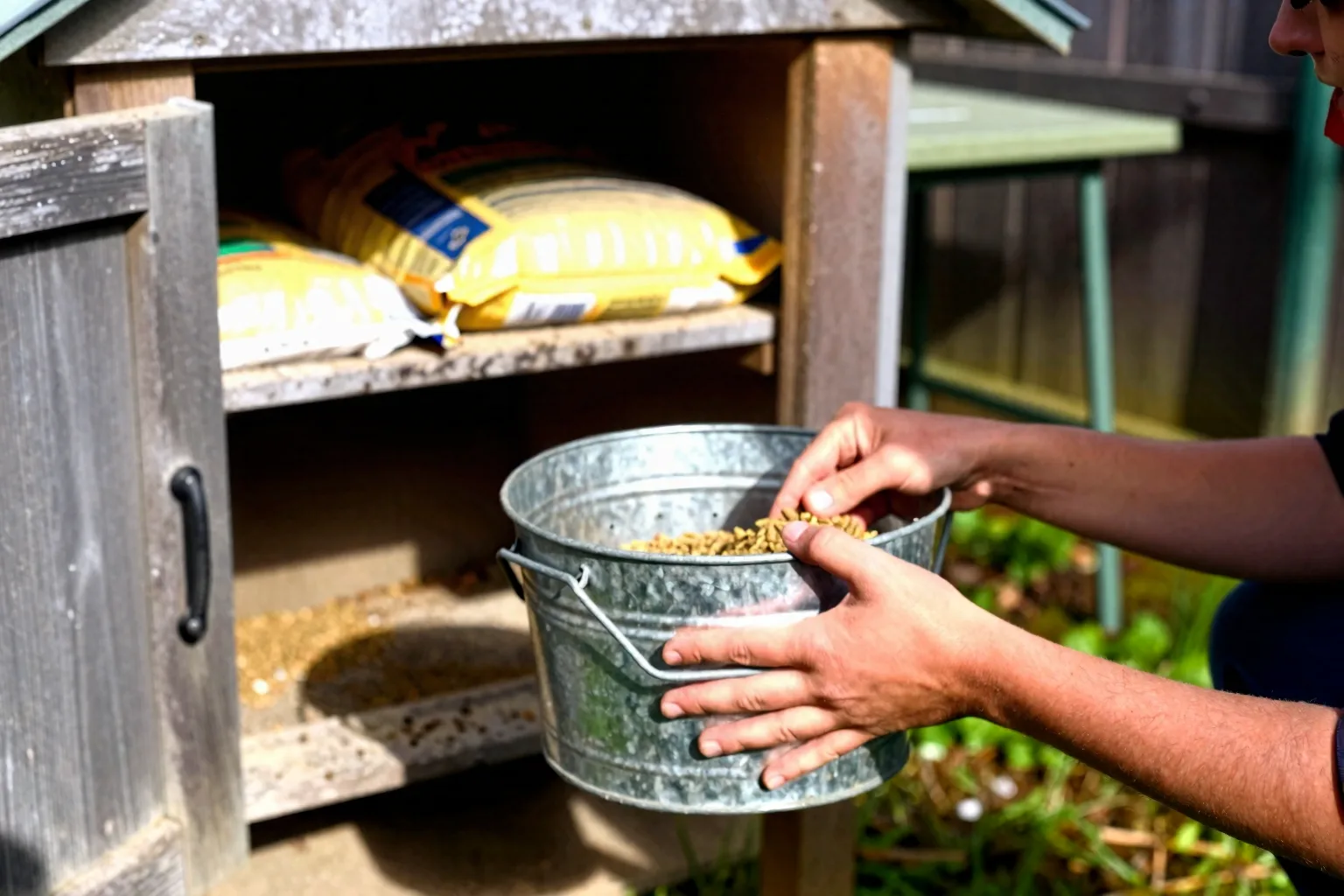
Why Flock Size Bends the Cost Curve
Here's the mechanism, and it explains most of the confusing advice you'll read. Your startup spend splits into two piles. One pile is fixed no matter how many birds you keep: the door, the hinges, the latches, the roof framing, the run gate, the feeder, the waterer, the feed bin. The other pile scales with birds: square feet of floor, feet of wire, nest boxes, roost length.
That fixed pile is why three hens is the worst deal per bird you can construct. A coop for three still needs a roof, a door, and a predator-proof gate — the same hardware an eight-bird coop needs. Go from three hens to six and the fixed pile doesn't move at all while the birds sharing it double, so cost per bird drops sharply. Go from six to twelve and it drops again, but less, because by then you're mostly buying more area and more wire, which scale honestly.
Feed does the opposite. Feed is close to perfectly linear — the twelfth hen eats exactly what the first one eats. So the total monthly bill climbs with every bird you add even as the per-bird startup cost falls. Both things are true at once, and confusing them is how people end up with fourteen chickens and a surprised look at the feed store.
My read: for most suburban yards, six to eight hens is the sweet spot where fixed costs are properly spread but the feed line is still small enough to ignore. Three is fine if three is what your ordinance allows or your yard fits — just don't expect the per-bird economics to look good.
Monthly Feed Costs: From Grams Per Bird to Dollars Per Bag
This is the calculation worth learning, because it's the only ongoing cost that really matters, and it takes about thirty seconds.
A mature standard-size laying hen eats somewhere in the neighbourhood of 100 to 130 grams of complete layer ration a day. Heavier dual-purpose breeds sit at the top of that; light Mediterranean-type layers sit at the bottom. Cold weather pushes intake up, because the bird is burning feed to hold body temperature. Genuine daylight-hours foraging on decent pasture pulls it down, though usually less than people hope.
Run it for six hens at 115 grams a day: 690 grams daily, about 21 kilos a month, which is roughly 46 pounds. That's a fraction under one 50-pound bag of feed per month for six birds. Twelve hens, two bags. Three hens, half a bag — and if you're only buying one bag every two months, check the mill date and store it sealed, because stale feed loses palatability and attracts everything with whiskers.
Now multiply by your bag price and you have your feed line. That's the whole thing. Look it up locally rather than trusting any figure in an article, including this one — feed prices track grain markets and vary a lot by region, and national commodity and food price trends are published by USDA's Economic Research Service if you want to see which way things are heading before you commit to a flock size.
One adjustment most budgets miss: waste. An open trough or a shallow pan lets hens flick feed out with their beaks — it's a natural foraging motion, not naughtiness — and with the open feeders I've seen in small coops I'd assume you're losing somewhere in the range of a tenth of every bag onto the bedding. Port-style feeders, a treadle feeder, or simply filling the pan half full and hanging it at the height of the birds' backs will claw most of that back. That's the cheapest saving available to you, and it costs nothing but a hook. For the full walkthrough, see how to calculate chicken feed cost per hen per month.
Chicks, Started Pullets, or Adult Hens: Which Costs Less Over a Year
Day-old chicks have the lowest sticker price and the highest total cost, and the gap is feed plus gear.
A pullet takes roughly 18 to 22 weeks to reach point of lay, depending on breed and the season she was hatched into. Across that stretch she eats a rising amount — very little at first, near-adult rations by the end — which averages out to something like 20 pounds of feed per bird before she produces a single egg. Six chicks is therefore around two and a half bags of feed spent on birds that are, economically, a pure liability. Add the brooder plate, the thermometer, the chick feeder, the extra bedding, and the five months of daily chores.
A started pullet at or near point of lay costs several times what a chick costs. Whether that premium is worth it depends almost entirely on flock size. At three to six birds, my call is that started pullets often come out roughly even or slightly ahead once you count the skipped feed and the brooder equipment you never had to buy. Push toward ten or twelve birds and chicks pull ahead, because the brooder gear is a one-time cost you're now spreading across more birds — and because chicks give you access to breeds that no local seller has as pullets.
Adult hens from a rehoming ad are the cheapest per bird and the biggest unknown. You rarely get a reliable hatch date, laying history is what the seller says it is, and you're bringing another flock's parasites and pathogens onto your property. If you go that route, quarantine well away from any existing birds for a few weeks and inspect around the vent and under the wings for mites before they mix. Prices for all three routes swing hard by region and season — call two local sellers rather than trusting a range.
The Recurring Costs Most Budgets Miss
Feed dominates, but it isn't alone, and the leftovers are where first-year budgets quietly go wrong.
- Bedding. Pine shavings, chopped straw, or hemp. How much depends on your method: a deep-litter coop gets topped up monthly and stripped twice a year; a small coop cleaned out weekly burns through bedding much faster. Deep litter is the cheaper method by a distance, provided the coop is dry and ventilated.
- Grit and oyster shell. Two different things, both offered free-choice in separate small containers. Insoluble grit does the grinding in the gizzard; oyster shell supplies calcium for shells. A bag of each lasts a small flock a long time, so this is a low line — but skipping the oyster shell shows up in thin, dented shells within weeks.
- Repairs and upgrades. Hinges sag, latches loosen, a corner of hardware cloth pulls free, a run roof needs a tarp after the first hawk visit. Assume something needs fixing every few months.
- Health. Poultry dust or spray for mites, and the possibility of an actual vet visit. Avian vets aren't in every town and aren't cheap — worth finding out now whether one exists near you rather than during an emergency.
- Winter power. A heated waterer base or a submersible de-icer is the one electrical item I'd genuinely budget for in a freezing climate. Read the wattage on the plate, multiply by realistic hours, and apply your own electricity rate — that's a small number, but it's not zero.
My working assumption when I sketch a flock budget is that these together add something like a quarter to a half on top of the feed line across a full year, front-loaded in the first winter and around the annual coop strip-out. Treat that as my planning figure to test against your own receipts, not a law.
Do Fresh Eggs Actually Pay You Back?
Depends what you compare them to, and on whether you count the coop.
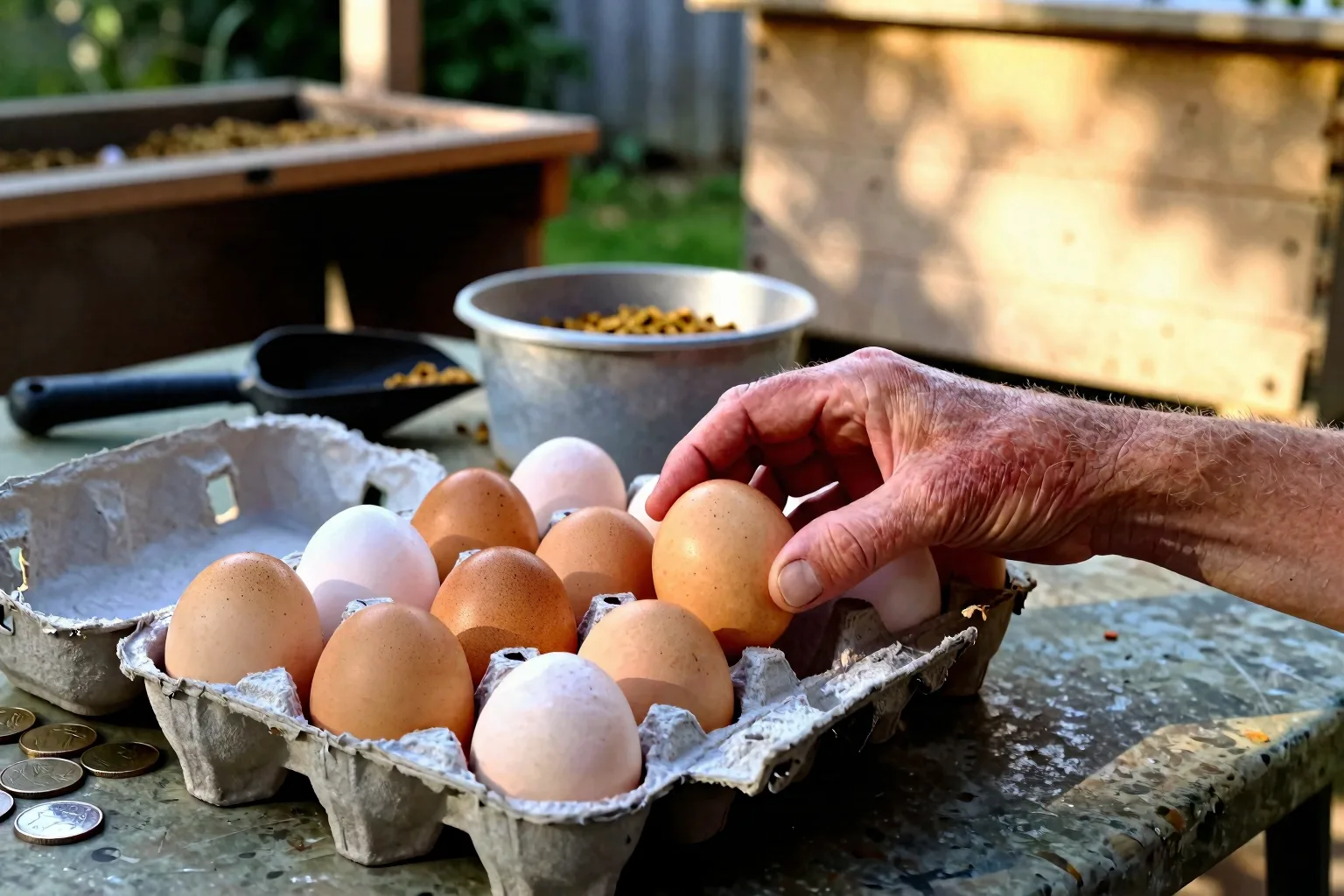
Take six productive hens of a decent laying breed in their first full laying year. Good layers are commonly reported to give something in the range of 200 to 250 eggs each in that first year, with a real dip during autumn moult and short winter days. Call it 1,200 to 1,500 eggs for the flock, which is roughly 100 to 125 dozen across twelve months, or about eight to ten dozen a month averaged out — though the actual pattern is a glut in spring and near-nothing in November.
Divide your monthly cost by that and you get a cost per dozen. Against feed alone, a well-run small flock can land in the same territory as mid-tier supermarket eggs and sometimes under it. Add bedding, grit, and repairs and it drifts upward. Amortise the coop over two years and the honest answer for most 3-to-12 bird backyard flocks is that the eggs don't repay the full cost inside the first year or two.
The comparison people should actually be making isn't the cheapest carton on the shelf. It's the premium pasture-raised eggs in the same store — that's the product you're producing, and against that benchmark a small flock competes far better. What I'd genuinely dispute is the framing itself: the coop is a garden structure you bought because you wanted chickens, the same way a raised bed is a purchase and not an investment in tomatoes. Run the numbers so you're not surprised, then buy the birds for the reasons you actually want them.
The two biggest levers on your cost per dozen, incidentally, aren't cheaper feed. They're cutting feed waste, and keeping hens through a second laying year instead of replacing them — a second-year hen lays somewhat fewer but usually larger eggs, and she costs nothing to acquire.
A Sample Monthly Budget for a 6-Hen Flock
Here's the template. Fill the right-hand column with your own numbers and you're done — the point of this table isn't my figures, it's the categories and how each one is calculated.
| Line item | How to calculate it | Your number |
|---|---|---|
| Layer feed | Roughly one 50 lb bag per month for six hens × your local bag price | |
| Bedding | Bales or bags used per month × price; deep litter uses far less than weekly clean-outs | |
| Grit and oyster shell | Bag price ÷ months it lasts — usually the smallest line on the sheet | |
| Repairs and consumables | Set aside a fixed small amount monthly; it gets spent in lumps, not evenly | |
| Health and parasite control | Annual dust/spray cost ÷ 12, plus whatever you're willing to hold for a vet | |
| Winter water heating | Device wattage × realistic hours × your electricity rate, cold months only | |
| Coop amortisation (optional) | Total build cost ÷ the years you expect it to last — include it or don't, but be consistent |
Two notes on filling it in. First, the feed line will dwarf everything else in most months, so get that one right before fussing over the rest. Second, budget by the year rather than the month if you can — chicken costs are lumpy. February brings the water heater and a feed price you didn't like; June brings almost nothing but eggs.
What Cutting Corners Actually Costs You Later
Cheap isn't free, and it's worth knowing exactly which corner charges you back.
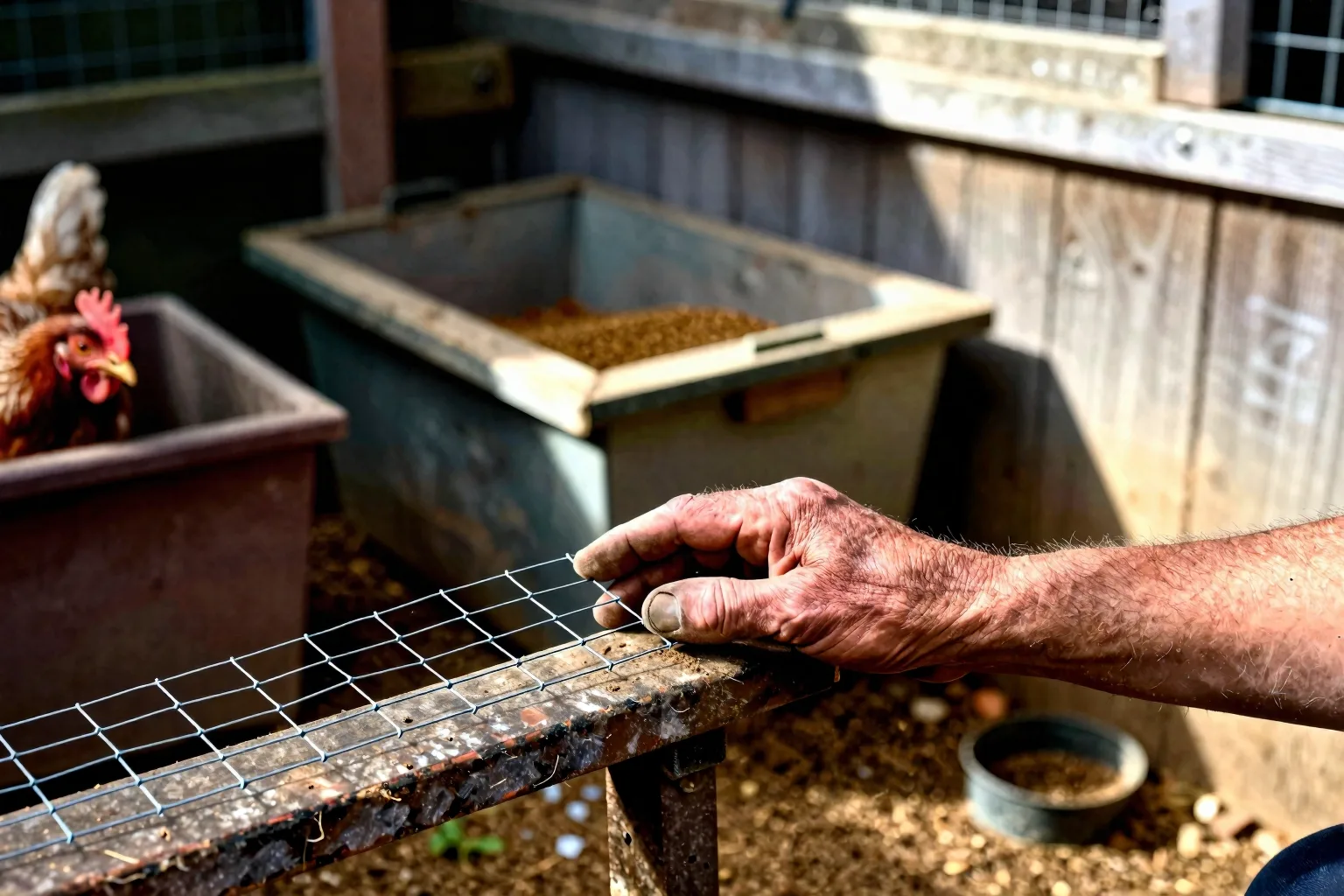
Chicken wire on the run. This is the one I'd argue hardest about. Chicken wire is designed to keep chickens in, not to keep anything out — the mesh is thin, the twists pull apart, and a raccoon has hands good enough to work through a hexagon or flip a simple hook latch. Half-inch hardware cloth on the lower few feet, with a flared or buried apron, plus two-step latches on every door, is the upgrade I'd make before almost any other. If the budget won't stretch to hardware cloth over the whole run, do the bottom three feet and the apron properly and use lighter wire above; height is not where the pressure comes from. The related question of whether to let birds out at all is its own calculation — is free-ranging your flock worth the cost and predator risk covers that trade-off.
Thin prefab panels. The failure mode is specific and slow: untreated thin timber swells with rain, the panels warp, gaps open at the joints, and now you have both a draught in January and a network of cracks that red mite will happily live in. You'll be sealing, replacing, or rebuilding within a couple of seasons. Read the material thickness in the listing, not the cute photo.
Bargain feed. Compare crude protein on the tag rather than price on the shelf — that figure, plus the mill date, tells you most of what you need. Under-formulated or stale feed doesn't announce itself; you notice hens eating more to compensate, or shell quality slipping, and by then you've spent the saving twice.
Undersized coop. The cheapest-looking corner and the one that charges the most interest. Crowded birds mean wetter litter, more ammonia, more bullying and feather-picking. Building one size up front is a discount on your future self's weekend. If you're at the planning stage, plan your coop and run before buying chicks rather than after.
Three Cost Questions That Come Up Later
Do I need a permit, and does that add to the cost?
Possibly, and it varies more than any other item here. Plenty of municipalities require a permit or a backyard-flock registration with a modest one-time fee; many cap flock size, set a minimum distance from property lines, or prohibit roosters outright. Some have no rules at all. There's no single figure to quote you, so call your municipal clerk or check the county ordinance before you order birds, not after — and if you're on an HOA property, read those covenants too.
Can selling extra eggs offset the monthly bill?
Partly. A spring glut from six hens can genuinely outrun your household, and neighbours will take the surplus. But egg sales are regulated, and the rules on labelling, grading, and where you're allowed to sell differ by state and country — check your state department of agriculture before putting a sign at the end of the drive. Realistically, treat neighbour sales as a discount on your feed bag rather than a business. Demand for backyard eggs is limited to the people who walk past your house.
Does breed choice change how much a flock costs to keep?
Yes, on both sides of the ledger. A heavy dual-purpose hen carries more body mass to maintain, so she eats more per day than a light laying breed simply to stay warm and alive. Then the laying side: a purpose-bred hybrid layer will out-produce most heritage breeds by a wide margin in her first year. Higher intake plus fewer eggs is what pushes cost per dozen up. That's not an argument against heritage birds — they're hardier, broodier, and often better company — but it is a cost you're choosing, so choose it knowingly.
Do This One Thing This Week
Weigh your feed. Put a full bag on a bathroom scale, note the number, feed as normal for seven days, weigh it again. Divide the difference by seven, then by the number of hens, and you have your real grams per bird per day — including your waste, your breed, your weather. Every other number in your budget hangs off that one, and it's the only figure in this article you can verify yourself for free.
If the answer comes back higher than you expected, the fix is almost never a cheaper bag. Start with the feeder height and the fill level, then look at what's getting into the coop overnight. And if you're heading into your first winter with the flock, the feed line is exactly where cold weather shows up first — worth reading up on winter care alongside your budget, because those two are the same conversation.
Worth saving this one and coming back to it when the first feed bag runs out. That's the moment the real numbers arrive.
Frequently Asked Questions
Do I need a permit, and does that add to the cost?
Many towns require a coop permit or backyard-flock registration with a modest one-time fee; some cap flock size or ban roosters. Point readers to check their municipal or county ordinance before buying birds, since fees and rules vary widely and can't be given as a single figure.
Can selling extra eggs offset the monthly bill?
A small surplus can bring in some cash locally, but most areas restrict casual egg sales (no grading/licensing needed only under a certain volume) and demand is limited to neighbors, so it rarely fully offsets feed costs for a 3-12 bird flock — treat it as a partial discount, not a business.
Does breed choice change how much a flock costs to keep?
Yes — heavier dual-purpose breeds eat more per day than smaller egg-laying breeds, and some breeds lay fewer eggs per year, which shifts the cost-per-dozen-eggs even when feed price stays the same.