How Much Feed Per Chicken Per Day Free Range: Step by Step
Plan on 110–140 g (about 4–5 oz) of complete feed per standard adult laying hen per day, even when she can roam. Use that as your opening offer, not a ration cap. Six standard hens at 120 g each start at 720 g a day; the full starting range would be 660–840 g.
Free-range forage can reduce what comes from the bag, but it doesn’t create a dependable pasture discount. Grass, insects, weather, breed, body size and laying rate all change the result. Your first useful number is the amount your flock consumes over seven days, not what an empty feeder appears to say on Tuesday morning.
Keep feed offered separate from feed eaten. A hen can bill feed onto the ground, rodents can carry it away, and wild birds can visit the feeder. The scale tells you what left your storage container. The audit tells you how much your flock probably used.
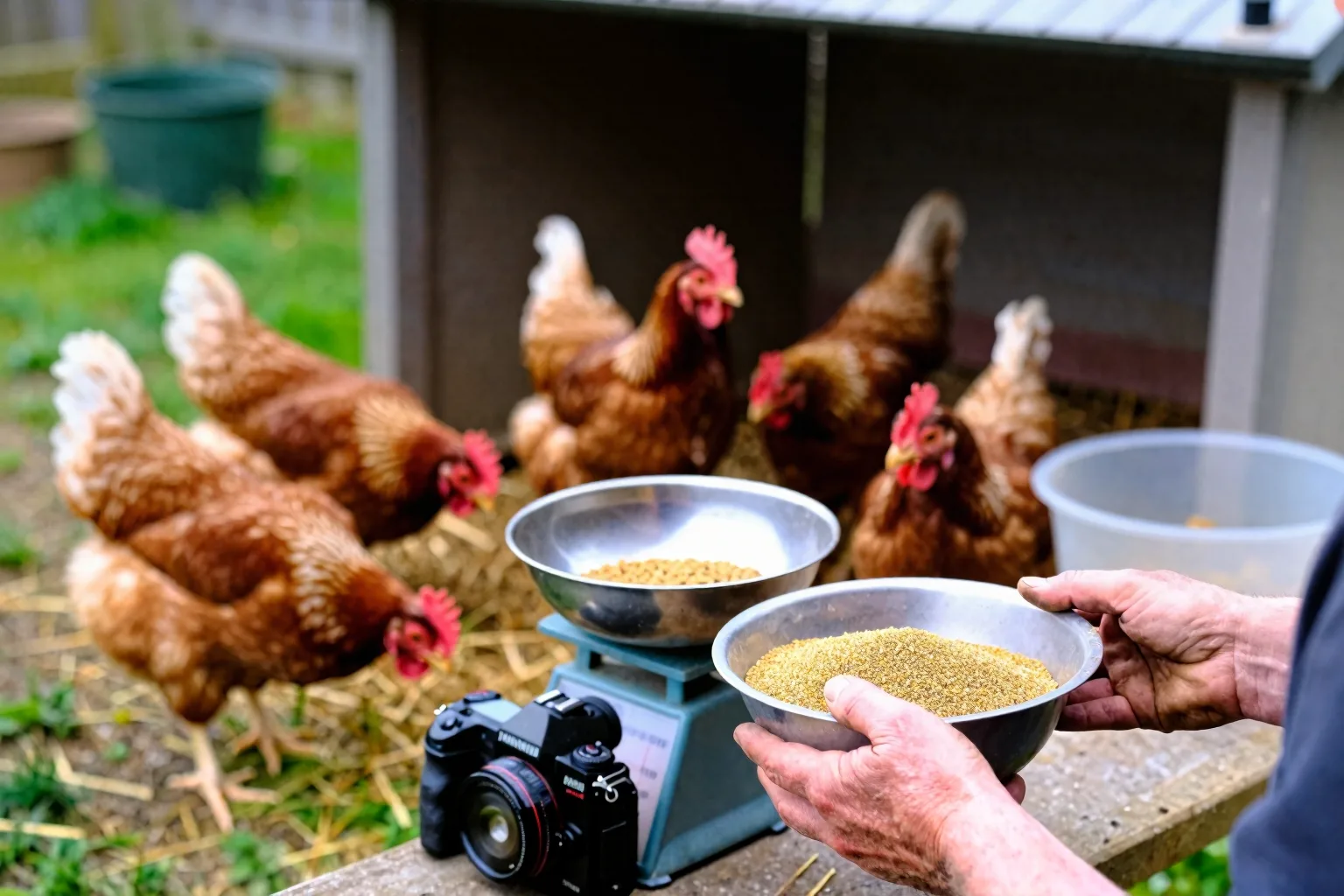
Start with 110–140 g for a standard adult layer
The practical starting point is 110–140 g per standard adult layer per day. Choose the middle of that range if you have no flock history, then adjust after you have measured real use. A productive green yard may lower bag consumption. A bare, frozen or drought-stressed yard may not.
| Bird group | Working starting range | How to use it |
|---|---|---|
| Small hens or bantams | 70–100 g daily | Begin lower, then check condition and egg output. |
| Standard adult layers | 110–140 g daily | Use 120 g as a simple planning midpoint. |
| Large or very active breeds | 130–170 g daily | Start higher if size, activity or cold weather warrants it. |
These are working bands, not amounts to enforce by taking food away. If your birds finish the feeder early but remain well covered and productive, first check for spillage and visitors. If they finish early while losing condition, don’t make them forage harder. Investigate access, feed quality and health.
Choose the starting number by bird size and age—not by acres of grass
Sort the flock before you do the multiplication. A small bantam, a heavy dual-purpose hen and a growing pullet don’t belong in one neat per-bird assumption.
- Standard adult layers: start with 110–140 g each.
- Small hens or bantams: start around 70–100 g, with the lower end for smaller, less active birds.
- Large or active birds: start around 130–170 g, then watch condition rather than breed name alone.
- Growing pullets: use a grower or developer ration until the feed label’s changeover point. Living outdoors doesn’t make a growing bird a layer.
- Roosters: size and activity matter more than the fact that the bird is male. A large, busy rooster may need more than a small, quiet hen.
For a mixed flock, add the starting amounts by bird. Two large birds at 150 g and four standard birds at 120 g come to 780 g per day. Six standard birds at 120 g come to 720 g. That is the amount to put into your measuring plan, not proof that every bird will eat exactly that much.
If pullets, roosters and layers share a run, check Layer feed versus all-flock feed for a mixed backyard flock before changing the ration. Feed choice follows age and flock composition. It doesn’t follow the amount of lawn available.
Set up the feeder so you can measure feed without forcing birds to forage
A kitchen scale and a dry container will give you a better answer than guessing from the level in a hopper. The aim is to measure consumption while keeping complete feed available and easy to reach.
- Put an empty, dry container on the scale and press tare. Record the date, bird count and starting amount.
- Pour the planned feed into the feeder. Write down the weight rather than relying on the scoop size.
- At each refill, weigh the new feed before it goes into the feeder. Add it to the running total.
- At the end of the audit, weigh dry leftovers and collect any clean, recoverable spill. Treat feed scattered into soil or bedding as waste, not as eaten feed.
Use a covered feeder in a dry position. Every bird should be able to reach it without being driven away. If one hen guards the only feeding point, add a second point far enough away that both can’t be controlled at once. An empty feeder is not a reason to make birds wait for their next measured portion; add a measured refill and count it as feed offered.
Keep clean water available beside the feeding area, but not where a tipped drinker can soak the ration. Offer oyster shell separately to laying hens where your feed plan calls for extra calcium. Provide insoluble grit when birds eat whole grains or substantial forage. Shell and grit do different jobs.
Complete feed should remain the anchor. Treats and scratch are easy to overvalue because birds rush toward them, but that excitement doesn’t show whether the flock has met its nutrient needs. The practical test is whether treats are displacing a visible part of the complete ration. For examples, see Safe chicken treats and how they displace complete feed.
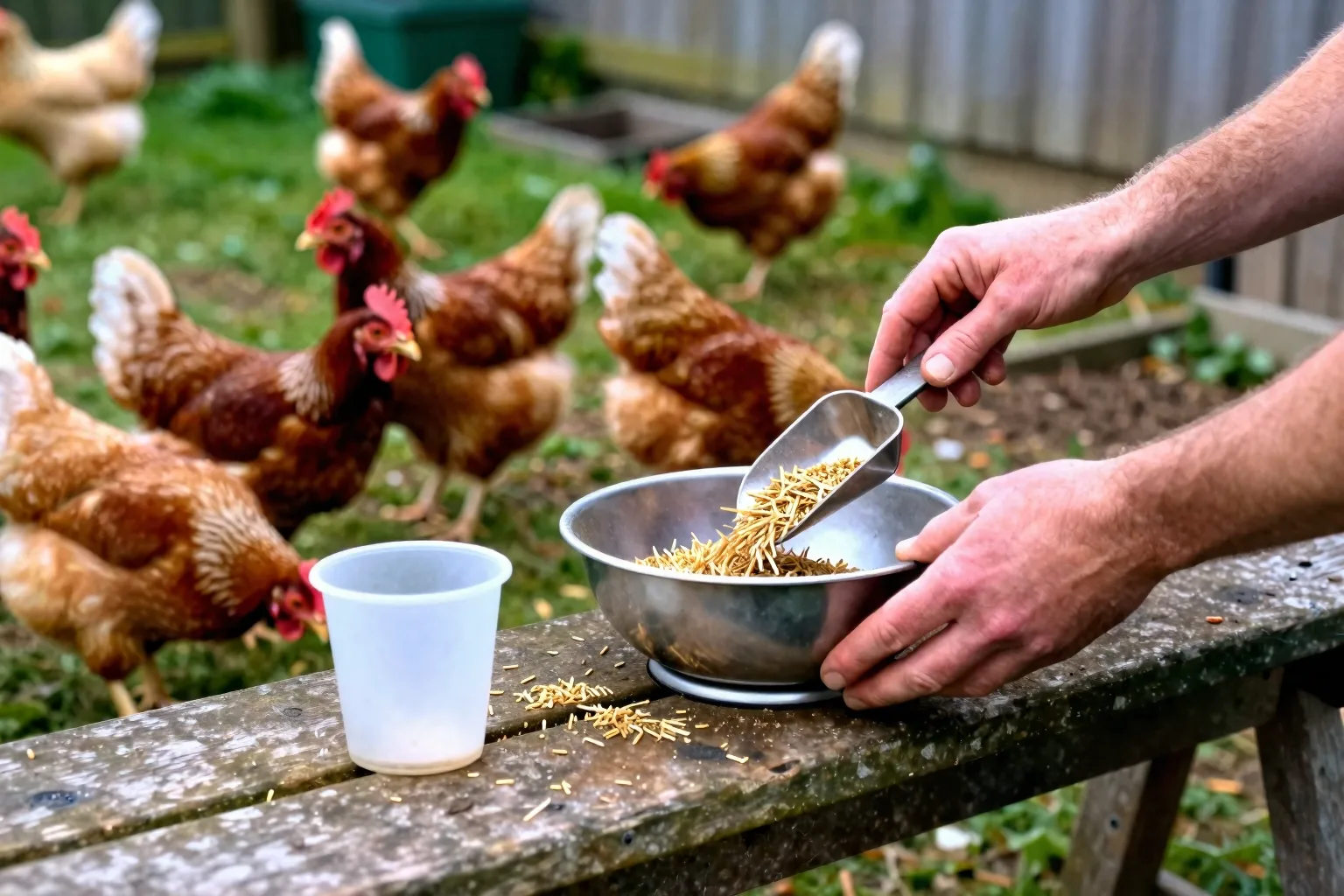
Run a seven-day audit before you change the amount
One day is noisy. A seven-day audit captures a weekend visitor, a wet feeder, a change in forage and the difference between a full and nearly empty hopper.
- Day 1: reset the feeder, weigh the starting feed and record the number and type of birds.
- Days 2–7: check at roughly the same time. Weigh every refill before adding it.
- At each check: weigh dry leftovers, look for bill-out around the feeder and note rodents, wild birds or wet feed.
- At the end: record whether the yard was lush, bare, muddy, snowy or drought-stressed, along with unusual heat or cold.
Feed consumed = feed offered − dry leftovers − recoverable spill. If a spill is mixed with soil or bedding and cannot be collected, leave it in your waste allowance instead of calling it eaten. Water-heavy feed also distorts the scale, so note wet or clumped material separately.
Divide the seven-day result by seven, then by the number of birds only if all birds had similar access and size. A mixed flock is more useful when you keep the groups separate in your notes. If the bag draw falls during a genuinely productive forage period, record that as an observation rather than inventing a permanent percentage reduction. When forage disappears, complete feed becomes a larger share of the diet. The audit can show whether that happened in your yard. The Winter chicken feeding and water checklist is useful before the first frozen week.
After the audit, make small changes. A 5–10 g per-bird adjustment is a workable trial step for a small backyard flock. Hold that change for another week while checking condition, eggs, waste and access. A small adjustment is easier to interpret than cutting the ration sharply because the grass looks green.
When the numbers look wrong, read the bird as well as the feeder
The feeder is a clue, not a diagnosis. Use this order of checks before assuming that free-ranging has solved, or caused, the problem.
| What you see | Check first | Reasonable next move |
|---|---|---|
| Feeder empty; birds look bright and condition is steady | Spill, bill-out, rodents, wild birds and flock size | Run the audit before increasing the offer. |
| Feeder empty; a bird is thin or eggs are falling | Feeder access, bullying, feed freshness and illness signs | Give the bird quiet access to feed and seek poultry advice. |
| Feed remains every day | Stale or wet feed, excess offer and feeder design | Remove spoiled feed and reduce only after checking condition. |
| Feed use rises suddenly | New birds, visitors, spillage, colder weather and lost forage | Inspect the run and feeder before changing the ration. |
| Feed use drops suddenly | Blocked access, a feed change, wet feed or reduced appetite | Watch individual birds rather than averaging the flock. |
| Soft or thin-shelled eggs appear | Ration, calcium access, age, stress and broader health | Correct access and check the feed label; persistent signs need advice. |
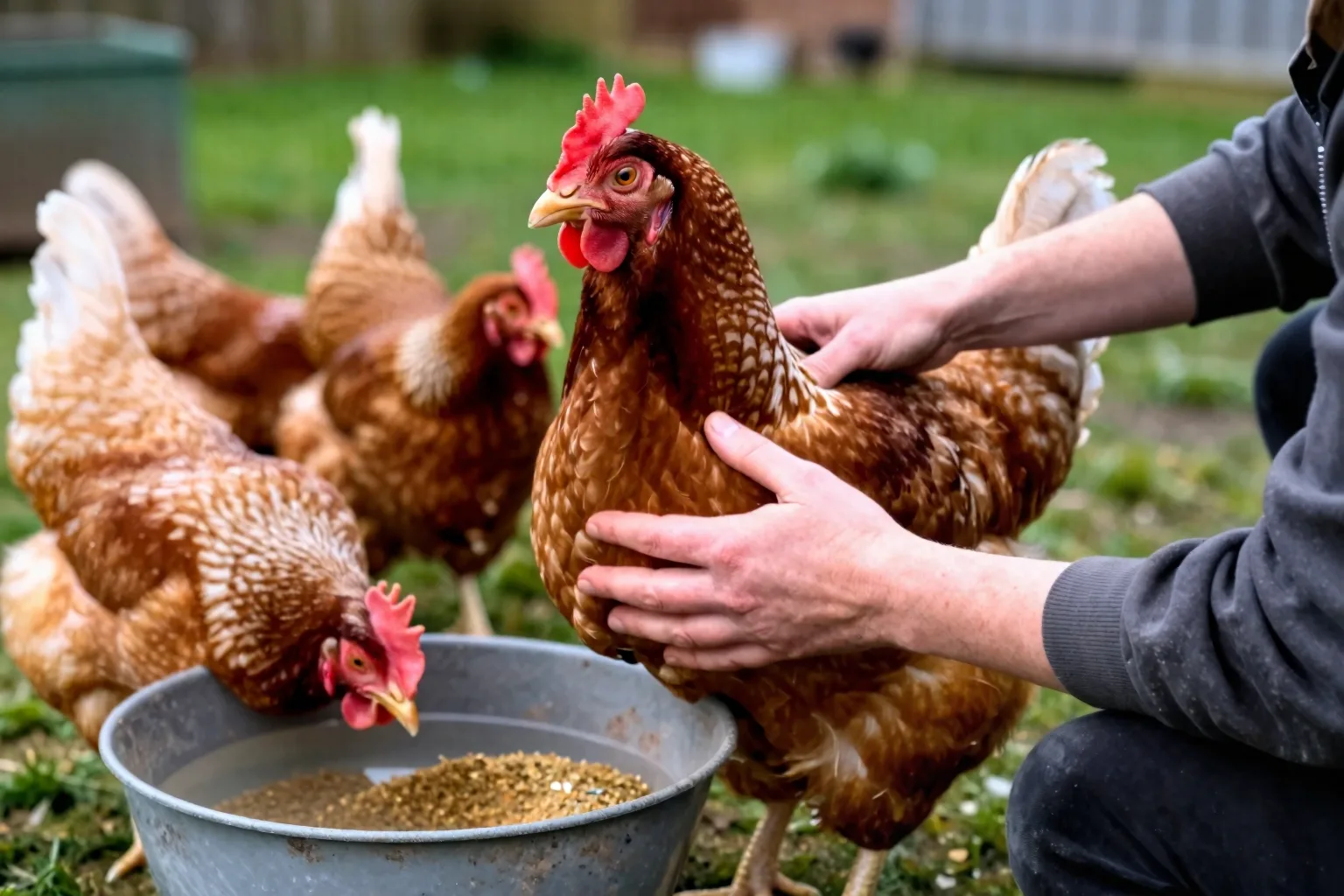
Once a week, catch each bird calmly and feel the keel and breast muscle. A prominent, sharp keel with little muscle on either side suggests poor condition. A keel that is difficult to feel because of excessive breast fat suggests the opposite problem. Feathers can hide both changes, so your hands are more useful than a quick glance.
Feed symptoms alone cannot tell you whether parasites, disease, bullying or poor feed access is involved. Reduced appetite, rapid weight loss, persistent diarrhea, breathing trouble, marked weakness or inability to reach feed are good reasons to contact a poultry veterinarian or local extension office. If one bird cannot compete, move it to a safe assessment space with feed and water while you arrange advice. Don’t try to solve a sick bird with a larger ration alone.
Turn grams into bags, monthly cost and one week’s task
Once you have a daily figure, the flock calculation is simple:
Monthly kilograms = daily grams per bird × bird count × 30 ÷ 1,000.
For eight standard hens at 120 g each, the flock uses a planned 960 g per day. Over 30 days, that is 28.8 kg before waste. Add a temporary 5–10% planning allowance for spillage and handling: 28.8 × 1.05–1.10 gives about 30.2–31.7 kg. That allowance is a budgeting cushion, not a claim that every flock wastes the same amount.
To estimate bags, divide the monthly kilograms by the bag weight and round up to a whole bag. At a 20 kg bag size, 30.2–31.7 kg means planning for two bags, with some carryover. To estimate cost, multiply the number of bags by the current local price for the exact feed and bag size. Check the store, feed type, bag weight and date because prices vary by region and season.
For the wider calculation, use Backyard chicken feed cost per month for 3–12 hens. Keep your own seven-day average beside the receipt. That gives you a budget based on your birds, not a generic pasture assumption.
This week, label one dry container for feed tracking. On day one, weigh the starting amount. For the next six checks, weigh every refill, record leftovers and inspect spill. Feel each bird’s keel at the end of the week, then use the seven-day average to set the next purchase. Free-ranging can add useful variety and reduce bag draw in the right conditions, but it shouldn’t be treated as permission to ration birds below what their condition requires.
Before changing feed type or calcium provision, compare your plan with feed-label guidance for poultry rations and agricultural extension guidance on free-range forage. The scale, the birds and the seven-day record will tell you what your backyard is actually doing.