How Much Feed Per Chicken Per Day Calculator: Step by Step
Six hens at 120 g each need 720 g before waste, weather, or spilled pellets enter the picture. Put that amount on a kitchen scale and the calculator stops being abstract. Add 10% waste, and the same flock needs 792 g placed into the feeder each day.
For a standard-sized adult laying hen eating complete feed in mild conditions, start with 100–150 g per bird per day. Then adjust the estimate for your birds, your weather, your forage, and what actually disappears from the feeder. The useful answer comes from a starting range plus a seven-day check, not one magic scoop.
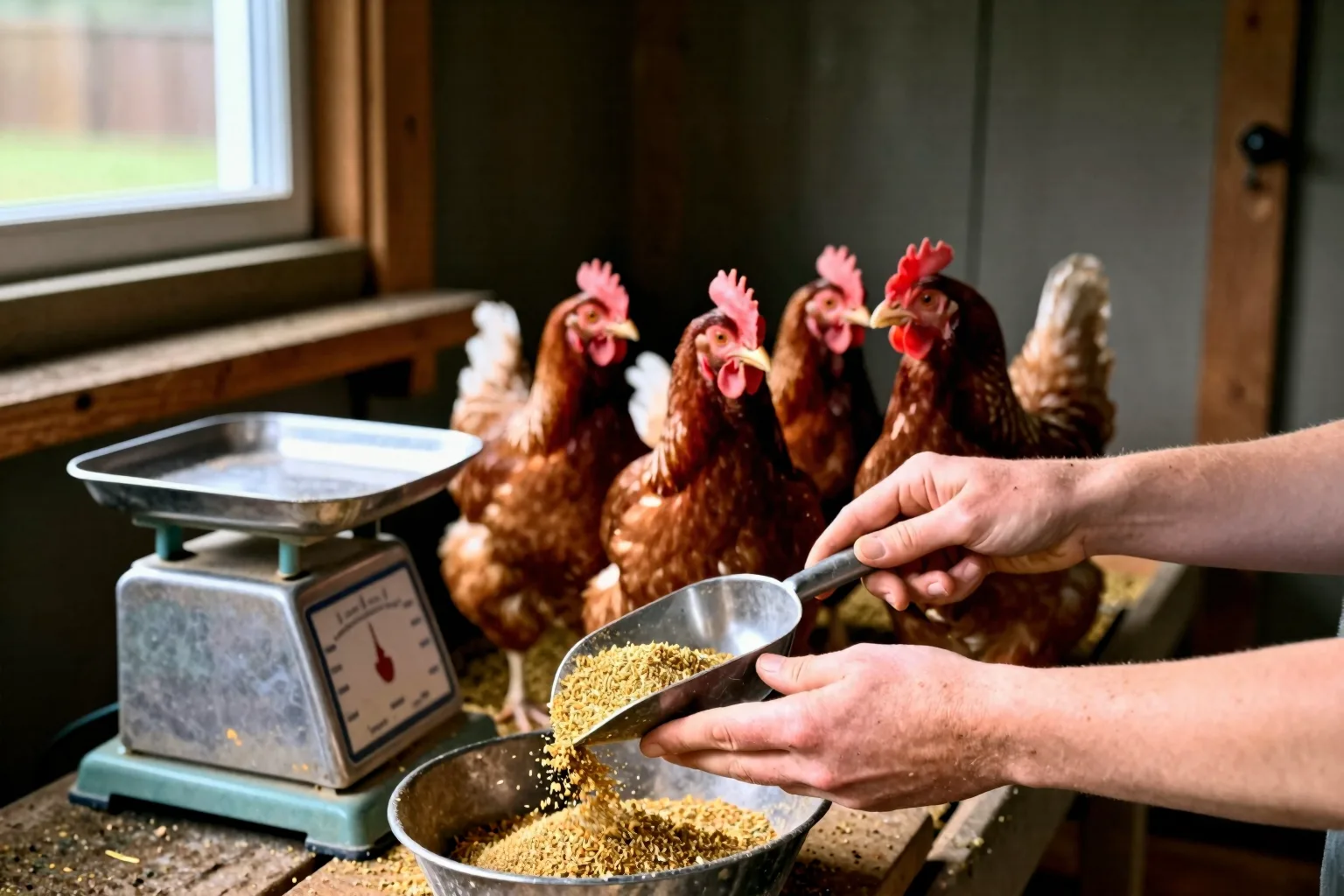
Start with 100–150 g for a standard adult layer
Use 100–150 g as a planning range, not as a ration you must force into every hen. The lower end may suit a smaller bird in mild conditions with little spillage. A large, active hen, a hard-laying flock, colder weather, or a messy feeder can push purchased feed toward the upper end.
That figure is mainly useful for buying and budgeting. It tells you whether your flock may use roughly 12 kg or 24 kg in a month. It doesn't tell you to remove the feeder after one exact serving. For adult layers, the practical default is a dry complete ration available as needed while you watch body condition, eggs, and waste.
Before you calculate, collect these five inputs
A useful chicken feed calculator needs five inputs. Write down each bird group separately. Layers, pullets, bantams, roosters, and meat birds shouldn't be reduced to one convenient average before you know what each group is eating.
| Input | What to record | Why it changes the result |
|---|---|---|
| Bird count | Each group and the total | Birds multiply the daily figure. |
| Age and type | Layers, pullets, chicks, roosters, or meat birds | Growth and purpose change the baseline. |
| Current feed | Product, form, bag weight, and label direction | Different feeds are not interchangeable inputs. |
| Expected waste | A starting allowance or a weighed seven-day figure | Spills, wet feed, rodents, and wild birds affect purchases. |
| Budget period | Usually 30 days, or your actual buying interval | It turns a daily estimate into kilograms and bags. |
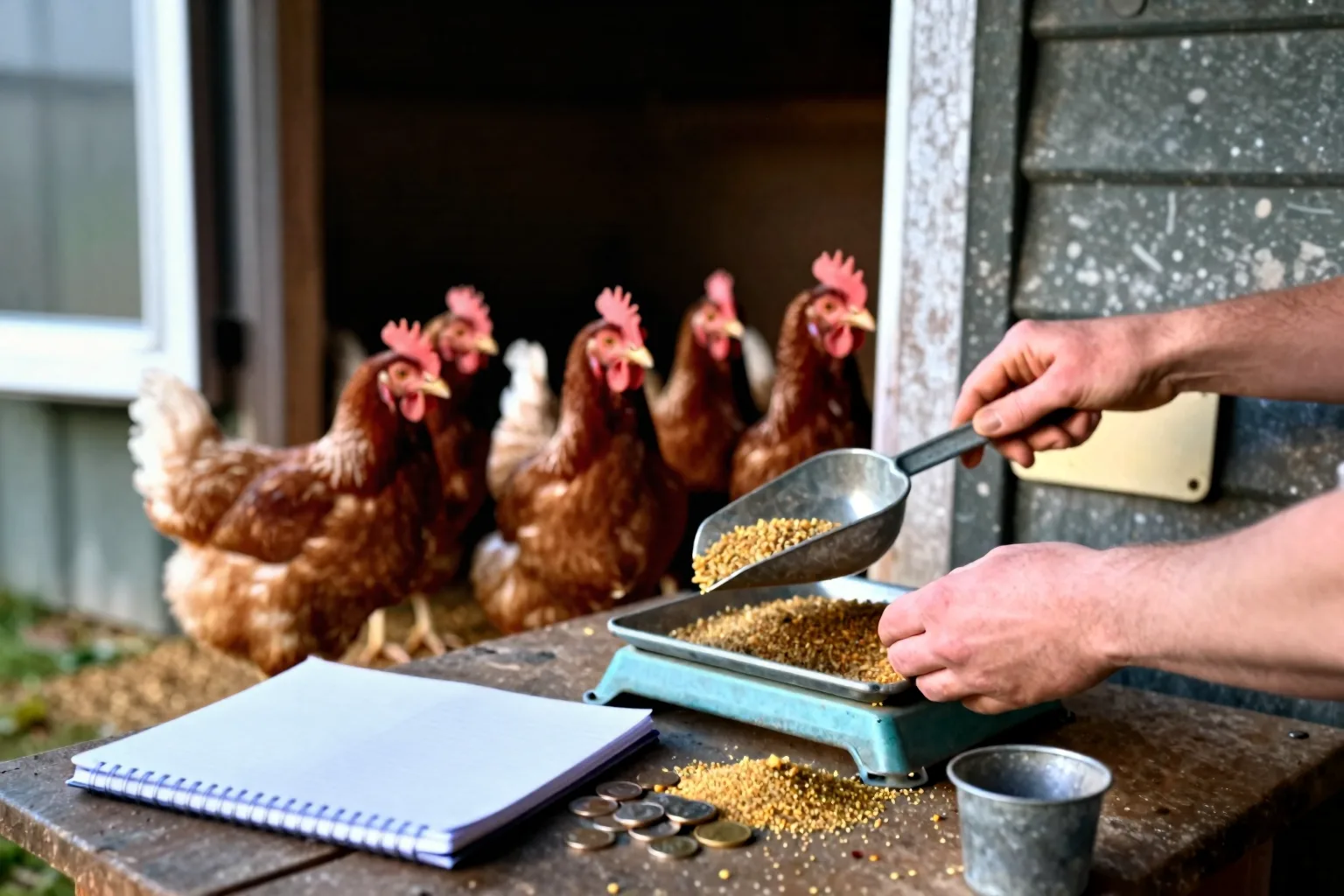
Also record regular access to grass, insects, whole grains, or treats. Don't turn those observations into an automatic subtraction yet. A green spring run and a short, dry lawn in August are different feeding situations, so forage belongs in the checking stage.
Step 1: Match each bird to the right feed baseline
Start with the manufacturer's feeding directions and guaranteed analysis on the bag. If the label gives a per-bird amount, record that figure first. If it gives only a free-choice direction, use 100–150 g as a working range for standard adult layers, then let your seven-day record replace the guess.
Don't apply an adult layer estimate to chicks or growing pullets. Chicks are developing quickly, pullets are still growing toward their adult size, and layers are being fed for maintenance and egg production. Meat birds follow a growth-oriented feed program, so their intake should come from the relevant label or program rather than an egg-layer estimate.
For mixed ages, calculate separately. For example, calculate four layers at their layer baseline, calculate two pullets from the figure on their grower feed label, and add the two results only after both calculations are complete.
Step 2: Adjust for weather, production, and access to forage
Cold weather can raise maintenance needs because your birds lose more body heat to the surrounding air. Heat can lower appetite for some birds, even as it makes shade and cool, clean water more urgent. A large, active hen can also use more feed than a small bantam under similar conditions.
Don't attach a fixed winter percentage to every flock. A dry, sheltered coop and a windy, exposed run create different demands. A molt, a change in laying rate, a new group of pullets, or a sudden cold snap can also make last month's average a poor guide for this month.
Forage may reduce purchased-feed use, but it doesn't provide a dependable percentage deduction. Grass, insects, seeds, and scraps vary with season, rainfall, stocking pressure, and the condition of the run. Begin with the label or planning range, make no automatic forage cut, and revise after measuring a full week. The practical water and energy details belong in Winter Chicken Feeding: Feed, Water, and Energy Needs.
Step 3: Decide how much feed your setup wastes
Feed poured into a feeder is not the same as feed eaten. If you add 1,000 g and recover 100 g of dry, usable feed, 900 g disappeared. Some may have been eaten. Some may be under the feeder, soaked by rain, carried off by rodents, or taken by wild birds.
A practical starting allowance is 5–10% for a tidy, dry setup and 10–15% where measurable waste is common. Those are planning allowances, not universal chicken rules. Replace them with a weighed figure as soon as you can. Rain-damaged feed still belongs on your feed bill even though it never becomes useful nutrition for your birds.
Step 4: Run the per-day and per-month formulas
Run the arithmetic in this order:
Flock feed per day = bird count × usable feed per bird × (1 + waste rate)
Use the waste rate as a decimal. Ten percent is 0.10, so the multiplier is 1.10. For a mixed flock, run the calculation for each group and add the group totals:
Mixed flock total = (layers × layer baseline × layer multiplier) + (pullets × pullet baseline × pullet multiplier)
For a monthly estimate, multiply daily grams by the number of days. Divide grams by 1,000 to get kilograms. Then divide monthly kilograms by the bag weight in kilograms. Round the shopping result up to a whole bag.
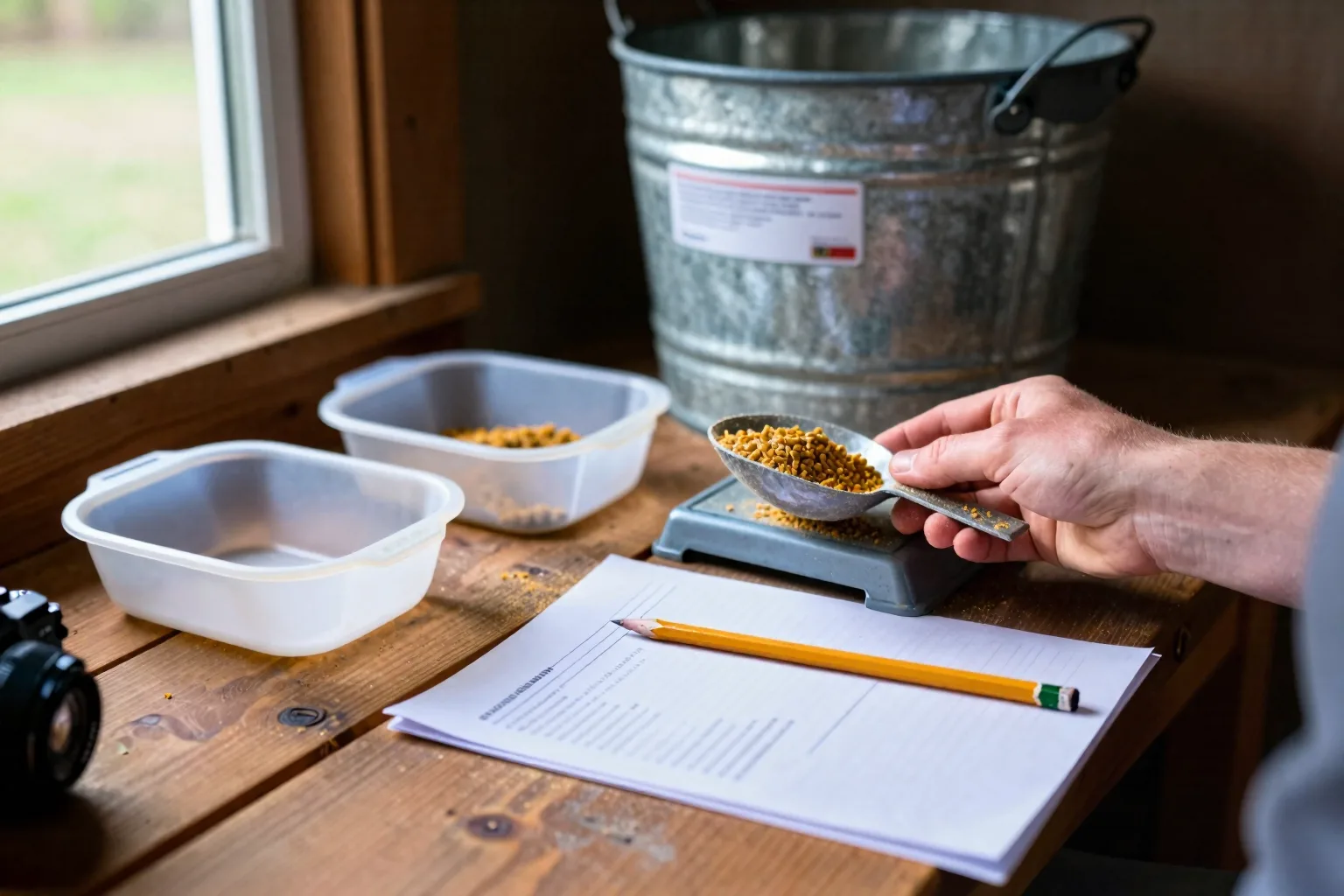
Three worked calculations for backyard flocks
These examples use a 30-day month and a hypothetical 20 kg bag to show the method. The pullet figure is an example input, not a recommendation. Substitute the direction on your own feed label.
| Flock | Calculation | Per day | 30-day use | 20 kg bags to buy |
|---|---|---|---|---|
| Four layers | 4 × 110 g × 1.05 | 462 g | 13.86 kg | 1 |
| Six layers | 6 × 120 g × 1.10 | 792 g | 23.76 kg | 2 |
| Four layers plus two pullets | (4 × 120 g + 2 × 75 g) × 1.10 | 693 g | 20.79 kg | 2 |
The six-hen example shows each step. Six hens at 120 g use 720 g as their usable baseline. A 10% allowance adds 72 g, bringing the feeder target to 792 g per day. Over 30 days, that is 23.76 kg. A 20 kg bag lasts about 25 days at that rate, so one bag won't cover the full month.
The four-layer flock uses 13.86 kg in the same example, so one 20 kg bag covers the month with feed left over. The mixed flock crosses 20 kg by less than a kilogram, but that still rounds to two bags. A fraction of a bag describes expected use; it isn't a sensible shopping quantity.
Turn kilograms into bags and a monthly budget
Use this formula for bags:
Bags needed = ceiling(monthly kilograms ÷ bag weight in kilograms)
For cost, first calculate the local price per kilogram:
Price per kilogram = bag price ÷ bag weight
>Monthly feed cost = monthly kilograms × local price per kilogram
As an illustration only, assume a 20 kg bag is priced at $20–$30. That gives a calculation price of $1.00–$1.50 per kilogram. The six-hen example would therefore represent about $23.76–$35.64 of feed used over 30 days, before local taxes, delivery, or the cash cost of buying a second partly used bag. Check current local prices and the exact bag weight before setting your budget.
Carry this monthly kilogram figure into How Much Does It Cost to Feed Chickens Per Month? for a fuller household calculation. Delivery charges and other flock costs can make the amount spent at the checkout differ from the value of feed consumed.
Set out the result without rationing your birds
The number you calculated is a purchasing estimate. It is not a command to give each hen a measured scoop and remove food at bedtime. Cutting access just to make the spreadsheet balance can leave quieter birds short while dominant birds take the available feed.
For adult layers, make a complete layer feed the core ration and offer it in a dry feeder that lets birds eat according to need. A covered feeder with a feed lip around back height can limit scratching and tossing. A feeder sized for roughly one or two days of calculated use is easier to inspect than a huge hopper left unattended for weeks.
If dominant birds block access, use two feeding points rather than cutting the total. If your flock includes a rooster, pullets, or non-laying birds, compare an all-flock ration with layer feed. The separate calcium-shell approach is explained in Layer Feed vs All-Flock Feed for a Mixed Backyard Flock.
Keep clean water beside the feed. Keep scratch grains and scraps outside the core calculation unless the whole diet is being measured. For portion guidance, see Safe Chicken Treats and How Much Is Too Much.
Use seven days of leftovers to check the estimate
A scale and a seven-day log will tell you more than a prettier spreadsheet. The aim is to measure disappearance, then investigate what portion was actually eaten.
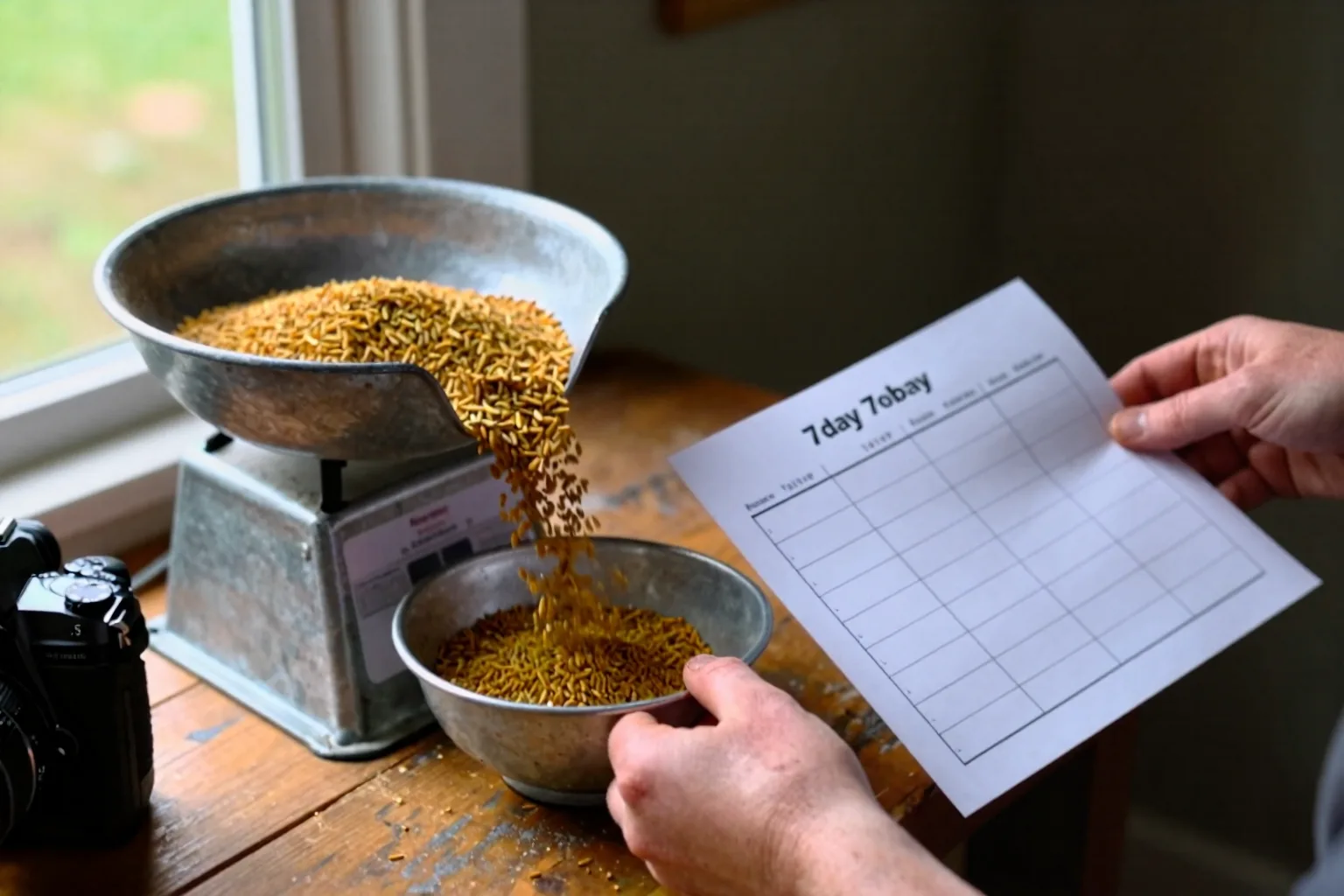
- Weigh the feeder or feed container at the start. Record every addition in grams.
- At the same time each day, weigh dry, usable leftovers. Don't count rain-softened, moldy, or caked feed as available leftovers.
- Record obvious spills separately. Weigh them if practical. Note rodent access, wild-bird access, and feed carried outside the run.
- Calculate the seven-day result as starting stock plus additions minus ending usable stock, then divide by seven.
This average measures feed disappearance, not perfect mouthful-by-mouthful intake. That is still the number you need for shopping. Pair it with body condition, eggs collected, droppings, flock changes, and the week's weather.
If feed disappears faster but your birds aren't eating more, inspect the feeder and perimeter for rodents, spilled pellets, and wet clumps. If one bird eats little and loses weight or becomes lethargic, that is not a calculator problem. Chasing a difference of a few grams can create more fuss than value while a wet feeder or rat is emptying it overnight.
When the number looks wrong: a quick diagnostic
| What you see | Check first | Useful response |
|---|---|---|
| The monthly total is wildly high or low | Grams-to-kilograms conversion and bag weight | Rework one day by hand before changing the estimate. |
| Layers and pullets share one figure | Age, purpose, and feed type | Split the groups and calculate each baseline separately. |
| Use changes after a weather shift | Cold, heat, water access, and shade | Record the condition and compare a new seven-day average. |
| Feed is wet, caked, or smells stale | Storage bin, feeder cover, and condensation | Remove spoiled feed and correct the storage problem. |
| Feed vanishes overnight | Rodents, wild birds, and openings around the feeder | Check tracks and droppings, then improve exclusion. |
| One bird eats less than its flockmates | Body weight, crop, droppings, breathing, and behavior | Separate for observation and seek professional guidance if it persists. |
Don't solve a sudden flock-wide change by simply adding or removing grams. First check water, feed freshness, access, weather, and whether a new bird or growing group has changed the denominator. Appetite change with weight loss, persistent diarrhea, breathing signs, marked weakness, or abnormal behavior calls for a poultry veterinarian or local extension office rather than a feed adjustment alone.
Does a rooster need the same amount of feed as a hen?
Don't count an adult rooster as zero. His working baseline depends mainly on body size and activity, so calculate him as his own adult group when precision matters. In a mixed flock, an all-flock ration with separate oyster shell for laying hens can be a practical arrangement rather than feeding a high-calcium layer ration to every bird.
Should scratch grains and kitchen scraps be subtracted from the calculator total?
Don't subtract an arbitrary percentage. Treats and forage vary in water, calories, and nutrients, and a scoop of scraps is not a repeatable feed input. Keep a complete ration as the base and treat extras as a small supplement. If extras become a large share of what disappears, weigh them too and revisit the diet with professional guidance.
Do chickens need grit if they eat commercial pellets or mash?
The mechanism matters. Insoluble grit is a supply of hard particles that can remain in the gizzard and help mechanically break down whole grains, seeds, and fibrous forage. Oyster shell supplies calcium for laying birds; it does not perform that grinding job, so it is not a substitute for grit.
If your birds eat whole grains, seeds, or substantial forage, offer poultry grit separately. Birds eating only complete pellets or mash may have less need for supplemental grit, but the answer changes with access to soil and the amount of whole material they consume.
This week, weigh one normal day's feed, write down your flock groups and bag weight, and start the seven-day log. Once you have that average, use How Much Does It Cost to Feed Chickens Per Month? to turn it into a local feed budget.
Frequently Asked Questions
Does a rooster need the same amount of feed as a hen?
An adult rooster needs an adult maintenance amount based mainly on body size and activity, so do not count him as zero; in a mixed flock, consider an all-flock ration with separate oyster shell for laying hens rather than relying on layer feed for every bird.
Should scratch grains and kitchen scraps be subtracted from the calculator total?
Do not subtract an arbitrary percentage because treats and forage vary in calories and nutrients; keep a complete ration as the base and treat extras as a small supplement rather than a replacement.
Do chickens need grit if they eat commercial pellets or mash?
Insoluble grit is mainly needed when birds eat whole grains, seeds, or substantial forage; oyster shell is a calcium source and is not a substitute for grit.